Tag Archives: State

Update 2: Australian sandalwood conservation

Michael Cornish
by email


Dear Michael

Thank you for your letter of 15 October, address to me as Chair of the Western Australian Threatened Species Scientific Committee at the Department of Biodiversity, Conservation and Attractions. The Department forwarded your letter to me.

I did read the paper by Richard McLellan et al. when it was published. I can understand your concern.

The Western Australian TSSC reviews nominations that have been submitted to them for the listing of flora as threatened flora under the WA Biodiversity Conservation Act 2016, in accordance with the provisions of the Act and Ministerial Guidelines. Members of the community may submit nominations at any time, following the Ministerial Guidelines, and using the nomination form available on the Department of Biodiversity, Conservations and Attractions (DBCA) web page, dpaw.wa.gov.au/plants-and-animals/threatened-species-and-communities/118-nominations.

As well as the list of threatened species, the WA priority flora list is a non-statutory list maintained by DBCA. Recommendations for addition to the priority flora list may be submitted to DBCA at any time, to [email protected]. Additions to the priority flora list do not require a nomination form. Priority list recommendations are not required to be submitted to or to be reviewed by the TSSC, although TSSC may make recommendations to DBCA on priority listings and DBCA may request TSSC advice on priority listings. Having a plant on the priority flora list does ensure that it is considered when environmental impact and other decisions are made, although that level of protection is not as high as threatened listing.

I am advised that a nomination for the listing of Australian Sandalwood (Santalum spicatum) as a threatened flora species has not been received, nor has a recommendation been received for addition to the priority flora list.

As the species occurs in WA and South Australia, the assessment of a nomination must also follow the requirements for cross-jurisdictional assessments under the Intergovernmental memorandum of understanding – Agreement on a common assessment method for listing of threatened species and threatened ecological communities, awe.gov.au/environment/biodiversity/threatened/cam. While WA TSSC may review a nomination for a species that occurs both in WA and in anther jurisdiction, and can recommend listing to the state Minister, it is sometimes simpler to nominate such a species to the Commonwealth TSSC; however, you should note that they have priorities set by their Minister, and a nomination may not be considered for some time if it does not fit the current priorities.

If a nomination of species that occurs both in WA and outside WA is received by DBCA, it will be considered by the WA TSSC and after the state Minister makes a decision whether or not to list, it is then referred to the Commonwealth. Except for emergency nominations, WATSSC typically meets once a year and its recommendations go to the state Minister within a reasonably short time.

I suggest that your best course of action would be to, in the immediate future, recommend sandalwood to the WA Flora Priority List and then fill in a threatened species nomination form so that the TSSC may consider recommending listing.

Yours sincerely

Dr Andrew A Burbidge AO
Chair WA TSSC

9 November 2021
Update 1: GIS data for SA nature park outlines

24 August 2021

Good Afternoon Michael,

Thanks for your query to NatureMaps Support and our apologies for the length of time it has taken to get back to you.

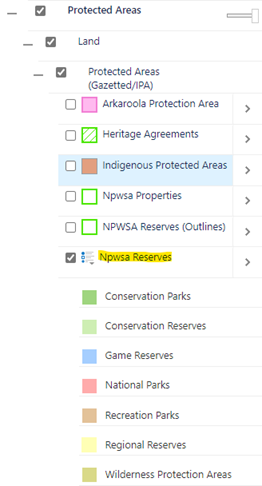
In case you weren’t aware, the Department for Environment and Water makes some of its key spatial data layers openly accessible through the Data SA web site – Data.SA.  You can find a version of the NPWSA Reserves layer (ie South Australian reserves dedicated under the National Parks and Wildlife Act, Wilderness Protection Act and reserves for conservation purposes under the Crown Land Management Act) in the following location – Conservation Reserve Boundaries – Dataset – data.sa.gov.au.  This version of the data is equivalent to the NPWSA Reserves layer in NatureMaps – see screenshot below


The procedure for supplying data to Google has changed over the years.  Previously, Google acquired a series of Australia-wide foundation data sets (including parks and reserves) from a National mapping distributor.  These National mapping data sets were updated on a regular basis from authoritative data supplied from State and Territory mapping agencies.  Under this approach, there was a clear pathway to provide updated mapping data to national and broader mapping initiatives.

Google has since stopped acquiring Australia-wide data from this National mapping distributor and now seems to favour a different approach for updating data.

Looking at information online, Google now promotes a Google Maps Content Providers program – Google Maps Content Partners – Content Providers – Google Maps.  Map Content Partners can provide their own data to improve information displayed on Google Maps – it looks like Parks and Protected Areas are part of the data that Google will accept.

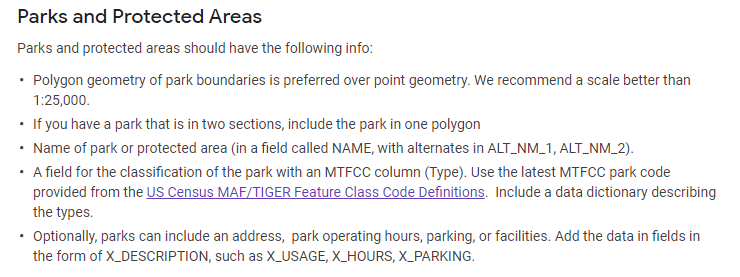
In order to submit mapping data under this partner program, Google has published some guidelines defining the required format and structure of the mapping data to be provided – Geo Data Upload Content Requirements – Map Content Partners Help (google.com).  For mapping data representing Parks and Protected Areas, partner data will need to adhere to the following guidelines.

Based on these guidelines, the South Australian NPWSA Reserves layer displayed in NatureMaps will require some “translation” to a data structure that will comply with the Google mapping requirements.  For this reason, it is probably best that this work is done by the department so that consistent routines can be established as part of a regular supply mechanism for Google mapping purposes.

We’ll coordinate with the department’s Parks and Communications teams to determine a way forward.

Thanks again for your interest.  Please let us know if you have any further questions.

Regards, NatureMaps Support

DEW Online Mapping

Science and Information Branch | Strategy Science and Corporate Services Division
Department for Environment and Water
81 – 95 Waymouth Street Adelaide, SA 5000
GPO Box 1047, Adelaide, SA 5001
environment.sa.gov.au

GIS data for SA nature park outlines

NatureMaps Support
Enviro Data SA
SA Department for Environment and Water
e: [email protected]


Dear NatureMaps Support,

Re: GIS data for Nature Parks and Wildlife SA (NPWSA) Reserves outlines

Thank you in advance for your time and consideration of my correspondence and for maintaining the NatureMaps application and website.

I am writing in my personal capacity with a keen interest in environmental conservation and in public accessibility to – and enjoyment of – our natural environment.

Google Maps is widely used by South Australians and visitors to our state to navigate to sites of public interest, including NPWSA Reserves, especially National Parks, Conservation Parks, and Recreation Parks. Currently, Google Maps is missing the outlines of several significant South Australian NPWSA sites, including Para Wirra Conservation Park, Anstey Hill Recreation Park, Cobbler Creek Recreation Park, Glenthorne National Park, and Sturt Gorge Recreation Park, to name but a few. I note that mapping of the NPWSA Reserves (outlines) data layer is available via the NatureMaps application.

For example, since providing GIS coordinates for Lawari CP to Google Maps a few years ago, there have been 50,000 public views of the photos assigned in Google Maps to the Park. Hopefully this demonstrates the public value, and especially tourism value, in having NPWSA sites properly shown on public mapping applications.

May I kindly request, can Enviro Data SA provide me with the GIS data – or instructions on how to access that data – for the NPWSA Reserves (outlines), noting my intention to provide this data to Google Maps?

If not, would Enviro Data SA be willing to provide the data directly to Google Maps?

Would it be possible to set up a process by which the data could regularly be made available (for example, annually) to publicly accessible mapping providers such as Google Maps?

Thank you again for your time and consideration of my correspondence.

Yours sincerely,

Michael Cornish

4 / 7 / 2021

Update 4: Aldinga Washpool

Mayor Erin Thompson
City of Onkaparinga
PO Box 1
Noarlunga Centre SA 5168


Dear Mayor Thompson,

Re: City of Onkaparinga, Aldinga Washpool, and the new Conservation Park

I hope this correspondence finds you well; you would remember me from my time as former Senior Policy Adviser to Ms Rebekha Sharkie MP. Thank you for your own ongoing efforts and support for permanent conservation of the Aldinga Washpool site.

I am writing to you in my personal capacity and out of a keen interest in environmental conservation. The permanent conservation of Aldinga Washpool was an issue I worked upon during my employment with Ms Sharkie, and since then I have been providing advice to the local Washpool Coalition and undertaking my own advocacy on the issue with the State Government.

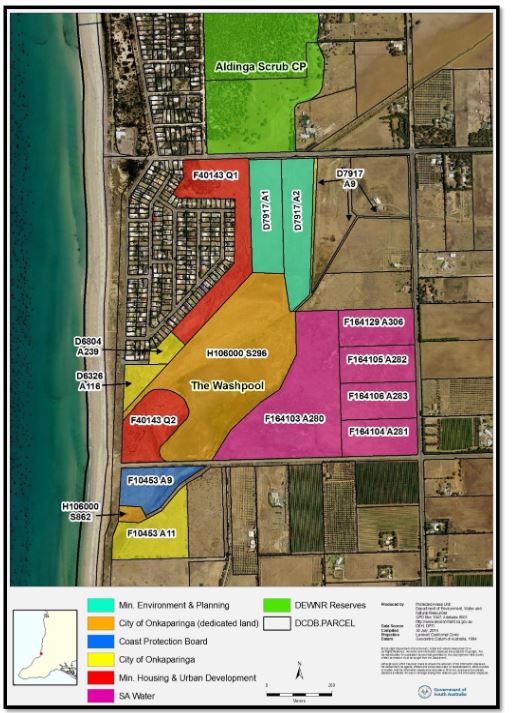
I too am concerned that there are land parcels at the Aldinga Washpool site that have yet to be confirmed will be a part of the eventual conservation park (as shown in the map at: https://www.parks.sa.gov.au/park-management/aldinga-washpool). These include land parcels which I understand are directly owned by the City of Onkaparinga, or is Crown land under their care, namely:

  • D7917 A9
  • D6804 A239
  • D6326 A116
  • H106000 S862
  • F10453 A11

May I kindly request an update on whether these parcels are still under Council ownership (and/or care), and whether there is active consideration for their addition to the new Conservation Park?

If so, what is the likely process (such as a vote at Council) and timing for a decision to be made by the City of Onkaparinga?

Thank you again for your support on this issue and for your time and consideration.

Yours sincerely,


Michael Cornish

21 / 6 / 2021

Cc Mr Geoff Hayter, Chair, Washpool Coalition

Update 3: Aldinga Washpool

[Map reproduced from: https://www.parks.sa.gov.au/park-management/aldinga-washpool]

96641 NPWS Aldinga washpool map v4

[Map reproduced from page 8, Washpool Lagoon Vegetation Survey and Mapping 2016, available here: https://www.naturalresources.sa.gov.au/files/sharedassets/adelaide_and_mt_lofty_ranges/coast_and_marine/aldinga-washpool-lagoon-vegetation-survey-mapping-2016-rep.pdf]


Update 2: Aldinga Washpool

[Reproduced from: https://www.premier.sa.gov.au/news/media-releases/news/aldinga-washpool-to-become-a-protected-area]

19/06/2021 | David Speirs MP

One of Adelaide’s last remaining coastal freshwater and estuarine lagoon systems will form part of a new conservation park at Aldinga with the Marshall Liberal Government stepping in to protect the area from potential housing development.

Aldinga Washpool, in Adelaide’s south is a well-known habitat for a wide range of native species, particularly birds and swamp plants of conservation significance, including a threatened coastal saltmarsh that’s nationally listed as a vulnerable threatened ecological community.

The Washpool is also of considerable spiritual and cultural significance to the Kaurna people and contains numerous archaeological sites and artefacts.

Minister for Environment and Water David Speirs said the Washpool land will be combined with the adjacent Aldinga Scrub Conservation Park to create one new conservation park.

“This is a significant moment for the local community who have been championing for the Aldinga Washpool to be protected for decades,” Minister Speirs said.

“The Marshall Liberal Government is committed to improving conservation and increasing the amount of open, green space available for people to explore and by combining the Aldinga Washpool land with the nearby Aldinga Scrub Conservation Park we will create a fantastic ecological and cultural haven just south of Adelaide.

“This follows the creation of Adelaide’s second metropolitan national park at Glenthorne and builds on our government’s record investment in open space and our historic push to increase the amount of space protected as national parks across the state.

“This is in stark contrast to the former Labor Government who ripped funding away from the environment and failed to rule out selling off these precious pieces of land to developers.

“In 2018, a Washpool Working Group was established, and we have been working closely with this group to ensure the land’s cultural and environmental values be protected and restored.

“The Department for Environment and Water, SA Water, Green Adelaide, City of Onkaparinga and other members of the working group have been working on flood mitigation, stormwater management, weed control, revegetation plans, water quality and protection of Aboriginal cultural heritage.”

“We will now work with the local community about the future management, and a planning process will commence next year to consolidate hydrological, ecological, and cultural work done so far.”

Recognising its cultural and environmental significance, and that it’s now surplus to SA Water operational requirements, the entirety of the Aldinga Washpool land has been transferred, encompassing five allotments totalling 31.64 hectares. There is also a mix of State Government tenures in the process of being transferred.

When complete, the total area of land added to park will be about 74 hectares.

Artificial reef election commitment

The Hon Steven Marshall MP
Premier
GPO Box 2343
Adelaide SA, 5001

Dear Premier,

RE: Artificial reef election commitment

I write to you as a former senior adviser to Ms Rebekha Sharkie, the Member for Mayo, with a keen interest in environmental conservation. I wish to commend the State Liberal Government on its 2018 election commitment to construct three artificial reefs.

Artificial, and especially oyster reefs, are an excellent economic and environmental intervention. In addition to improved water quality, increased marine biodiversity and the creation of new recreational fishing opportunities, The Nature Conservancy estimates that every million dollars invested in oyster reef restoration creates 8.5 full-time equivalent jobs.

My understanding is that separate to the original pilot oyster reef of Windara near Ardrossan, the three reef projects are the Glenelg reef (construction now complete), a reef near Noarlunga, and the Kangaroo Island reef near American River.

It appears that the Glenelg reef was constructed with State Government funding, but it is unclear what contribution – if any – the State Government is making to fund the second and third reefs alongside the welcome Reef Builder funding announcement from the Federal Government.

May I kindly inquire, will the State Government be making financial contributions to the Noarlunga and Kangaroo Island oyster reef restoration projects? If so, how much over what time frame, and if not, why not?

Although preferably the State Government would contribute an amount that at least matches the Federal Government funding envelope, will the State Government consider contributing at least a nominal amount to the Noarlunga and Kangaroo Island reef projects in order to confirm its bona fides in delivering on its election commitment?

Thank you for your time and consideration of my correspondence.

Yours sincerely,

Michael Cornish

18 / 4 / 2021

Cc Minister for the Environment, the Hon David Speirs MP

Aldinga Washpool

The Hon Steven Marshall MP
Premier
GPO Box 2343
Adelaide SA, 5001

Dear Premier,

RE: Conservation of the Aldinga Washpool site

I write to you as a former senior adviser to Ms Rebekha Sharkie, the Member for Mayo, with a keen interest in environmental conservation. It was during this time that I became familiar with the current situation regarding the Aldinga Washpool site.

The Aldinga Washpool is one of the last remaining coastal freshwater and estuarine lagoon systems along the Adelaide metropolitan coast and includes a threatened temperate coastal saltmarsh, which is nationally listed as a vulnerable, threatened ecological community under the Environment Protection and Biodiversity Conservation Act 1999 (Cth).

With even limited investment in environmental restoration, the Washpool can also provide considerable social benefits and economic (environmental tourism, especially birdwatching) opportunities to the local community and its visitors.  Currently, ownership of the Washpool site is fractured amongst several Government stakeholders, including SA Water, the City of Onkaparinga, the Coastal Protection Board, and State Government Departments. There have been local community concerns that parcels of Washpool land may be sold for development.

A coalition of environmental, community and local business groups has been forming to pursue a State Government commitment to conservation of the Washpool site. A commitment to permanent conservation of the Aldinga Washpool site is an opportunity for the State Government to cement their local social, economic and environmental credentials with the Aldinga and surrounding communities within the Mawson electorate.

You would no doubt be aware that Mawson was the most marginal electorate in last the South Australian election and remains a highly marginal seat in the forthcoming 2022 State election. Labor has made a public commitment to conserve the Aldinga Washpool in its entirety, although their statements have omitted any detail on the how, when, or vision for the site.

As I understand it, your Government has been considering the conservation proposition for the Washpool for some time.

Now is the time to match – and surpass – Labor’s commitment.

A clear public commitment to a durable conservation solution for the Washpool site – for example, its annexation to the adjacent Aldinga Scrub Conservation Park – including a clear timeframe for delivery and modest investment in improving the site’s general environmental amenity, would be of great benefit to the local community and all South Australians, would outperform Labor’s commitment, and would certainly delight the gathering strength of the local coalition of environmental, community and business groups pursuing the Washpool’s conservation.

I strongly encourage the State Government to act decisively on this opportunity.

Thank you again for your time and consideration of my letter.

All the best,

Mr Michael Cornish

10 / 3 / 21

Cc Minister for the Environment, the Hon David Speirs MP
Cc Ms Sascha Meldrum, State Director, Liberal Party SA
Cc Cr Simon McMahon, South Coast Ward, City of Onkaparinga